Spider mites on almost every plant we own
Spider mites did not get one of our plants. They got almost all of them.
That is the thing nobody really warns you about. Spider mites are not a problem of one sick plant on a windowsill. They are tiny, they move from leaf to leaf and plant to plant, and by the time you notice them on one, they are usually already on the neighbours. Our Alocasias, which we keep close together, were an easy target.
This is what the damage looked like, what we sprayed, and the one detail that matters more than the recipe.
What it looked like
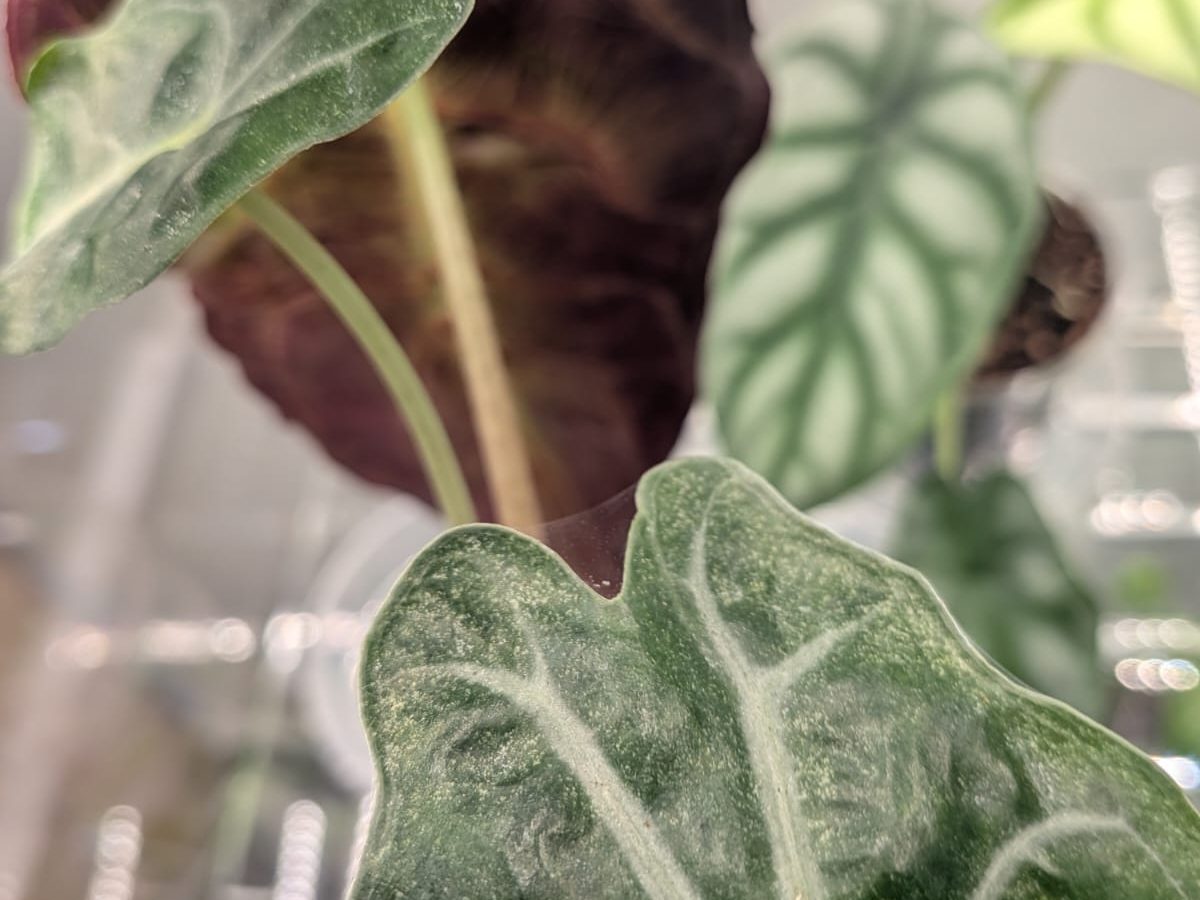
The photo at the top of this post is one of our Alocasias. If you look closely at the green leaf in front, the surface is covered in tiny pale dots, as if someone had dusted it with fine sand. In the notch at the top of the leaf there is a thin web, stretched from one side to the other.
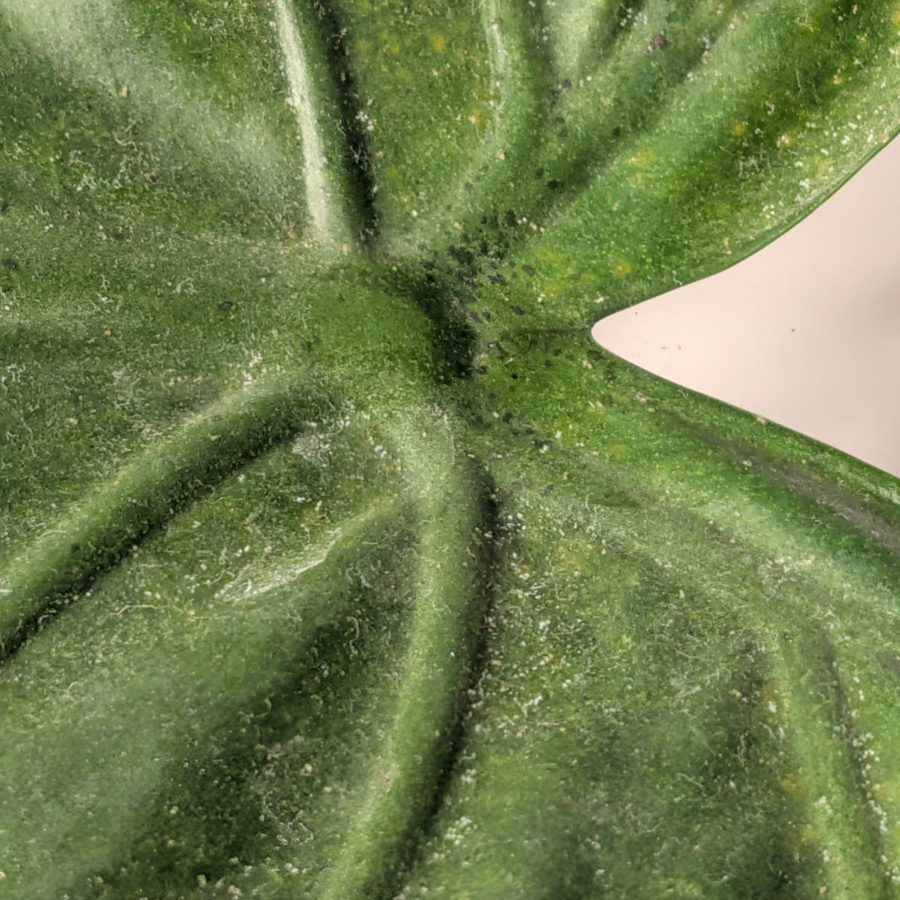
Up close it is clearer. Those pale dots are where the mites have pierced the leaf cells and sucked them empty. The dark specks gathered along the veins are the mites themselves, their shed skins and their droppings. On a velvety Alocasia leaf it is easy to mistake all this for dust, which is part of why mites get as far as they do.
The signs to look for, on any plant:
- Speckling. Fine pale or yellow dots, usually starting near the veins and spreading.
- Webbing. Thin webs in the angles between the leaf and the stem, in the notch of a leaf, or across a new leaf that is still unrolling.
- A dull, tired leaf. A leaf that was glossy and now looks matte and faded.
- Moving dots. Wipe the underside of a leaf with a white tissue. If you see tiny red, brown or pale smears, those are mites.
Check the undersides of the leaves first. That is where they live and lay their eggs.
Why our plants were such an easy target
Spider mites love warm, dry air. Inside a home, especially with the heating or air conditioning on, the air is often drier than most tropical plants like. Alocasias, with their big soft leaves, are among their favourites.
The other reason was simple: our plants stand close together. A mite does not need to fly. It walks, and it can drift on air currents on its own silk. When leaves touch, or plants share a shelf, one infested plant becomes several very quickly.
What we sprayed
We mixed a spray based on neem oil, with a few other ingredients to help it spread and stick to the leaf, and sprayed almost every plant, not just the ones where we could see damage.
We did it twice, a couple of days apart.
That is the detail that matters. A spray reaches the mites that are on the leaf at that moment. It does much less to the eggs, which hatch over the following days. If you spray once and stop, a new generation hatches, and a week later you are back where you started. The second round catches the young mites that hatched after the first one, before they are old enough to lay eggs of their own.
A few things we would tell anyone using a neem oil spray:
- Test it on one leaf first. Spray a single leaf, wait a day, and check it for damage before you treat the whole plant.
- Cover the undersides. That is where most of the mites are. Spraying only the top of the leaf misses most of them.
- Do not spray in strong sun. An oily film on a leaf in direct sun can burn it. Spray in the evening or keep the plant out of direct light until it dries.
- Shake the mix often. Oil and water separate. If you do not shake the bottle, the first sprays are mostly water and the last ones mostly oil.
- Treat the neighbours. Spray every plant that stands near an infested one, even the ones that look clean. That is why we sprayed almost everything.
Where we are now
Honestly: we think they are gone. The new growth looks clean and we have not seen fresh webbing.
But "we think" is the right phrase with spider mites. They are hard to see, and a few survivors can rebuild a population in a couple of weeks. So the job is not finished when the speckling stops. For the next few weeks the thing to do is keep checking: the undersides of the leaves, the notches, every new leaf as it opens. If webbing or fresh speckling appears, spray again, twice, a few days apart.
Old damage does not heal. A leaf that was speckled stays speckled. What you are looking for is whether the new leaves come out clean.
Keeping them away
Nothing guarantees they will not come back, but a few habits make it much harder for them:
- Look at leaves regularly. A quick look under a few leaves when you water catches mites while it is still one plant, not all of them.
- Keep new plants apart for a while. A plant from a shop or a friend can bring mites with it. Keep it away from the others for a couple of weeks and check it before it joins them.
- Wipe or rinse the leaves. Mites dislike being washed. Wiping big leaves with a damp cloth, or rinsing a plant in the shower, removes many of them and the dust they hide in.
- Do not let the air get very dry. Grouping plants raises the humidity a little, but as we found out, it also helps pests travel. Give plants a little space so the leaves do not touch.
Our more general guide to spider mites covers the other ways to treat them, from washing to other sprays, if neem oil is not an option for you.